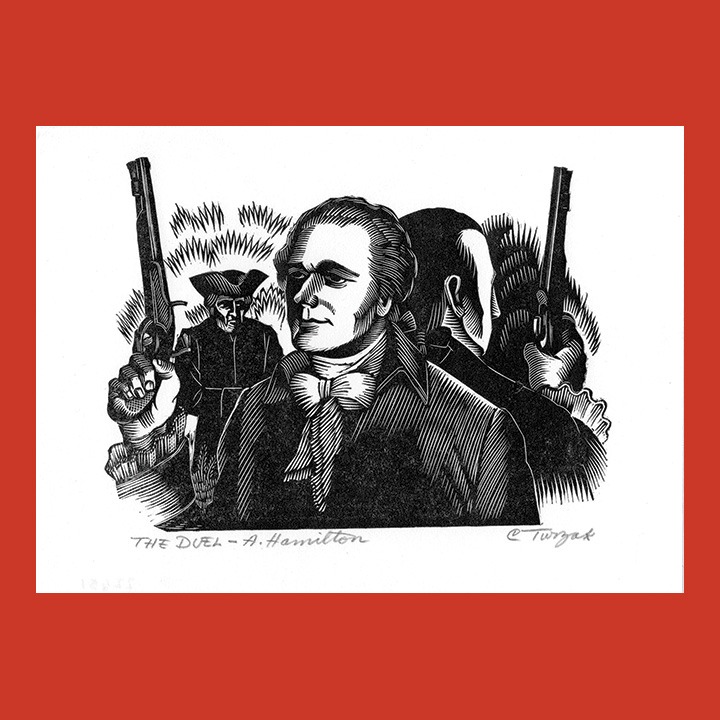
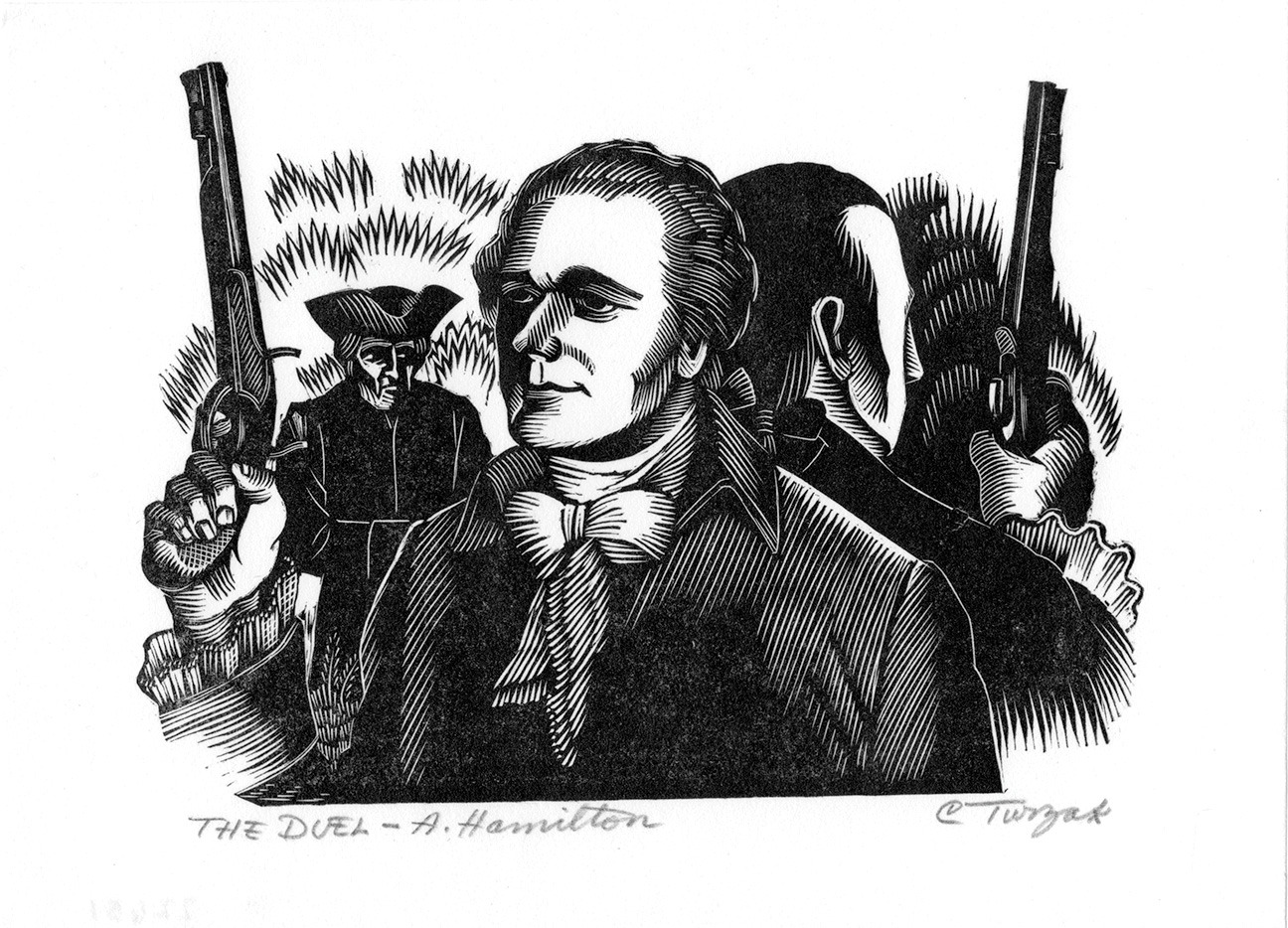
Charles Turzak, Alexander Hamilton, The Duel, Woodcut Print
$385.00
Got Milk?
In stock
Description
Alexander Hamilton, “The Duel” A. Hamilton. Woodcut on paper, 1939; 6 1/2” x 8”
Signed and titled in pencil.
About Charles Turzak
Charles Turzak (Am. 1899 – 1986) was an American painter, printmaker and teacher born in Streator, Illinois.
His immigrant parents hoped he would fall into a professional career, but Turzak had discovered a love for the arts. He was known for make animal carvings out of peach seeds and drawing cartoons to sell. After winning a cartoon contest, sponsored by The Purina Company, Turzak enrolled at the School of the Art Institute of Chicago. Having been an apprentice to a violin maker as a boy, he was drawn to the art of woodblock printmaking, which proved to be his favored medium.
After traveling through Europe in 1929, Turzak returned to a country grappling with The Great Depression. He made ends meet with a mixture of fine art and commercial work. One of the books he illustrated was John and Ruth Ashenhurst’s All About Chicago (1933). It was also during this time he started working on his own book, Abraham Lincoln: A Biography in Woodcuts (1933). Turzak carved many of the blocks and printed and produced the book at the 1933 Century of Progress Exhibition. The book’s success paved the way for the production of a similar publication, including The Life of Benjamin Franklin (1935). Other examples of Turzak’s works in the Chicago area include several murals produced as part of WPA programs. Most have been lost, however his mural Canal Boats has recently been restored. It is on display at the Lemont, IL post office.
Turzak’s work made a dramatic shift from modernism to abstraction in the 1950s. He continued to make woodcuts until the late 1970s, when age became a restriction, but did not inhibit his ability to create. He continued to produce paintings up until his death in January on 1986, and had his last one-man show just eight months prior.
Turzak was a man who fully embraced modernism, even in his choice of abode. He commissioned Bruce Goff to create a home and studio on the far north side of Chicago, that still stands today.
Related products
-
Abraham Lincoln, Modern Photograph, O-41, black & white
$295.00 -
Abraham Lincoln, Modern Photograph, O-77, 8″ x 10″ albumen-toned
$75.00 -
Abraham Lincoln, Modern Photograph, O-20, albumen toned
$75.00 -
Ellsworth Zouaves Membership Certificate Print
$1,100.00